

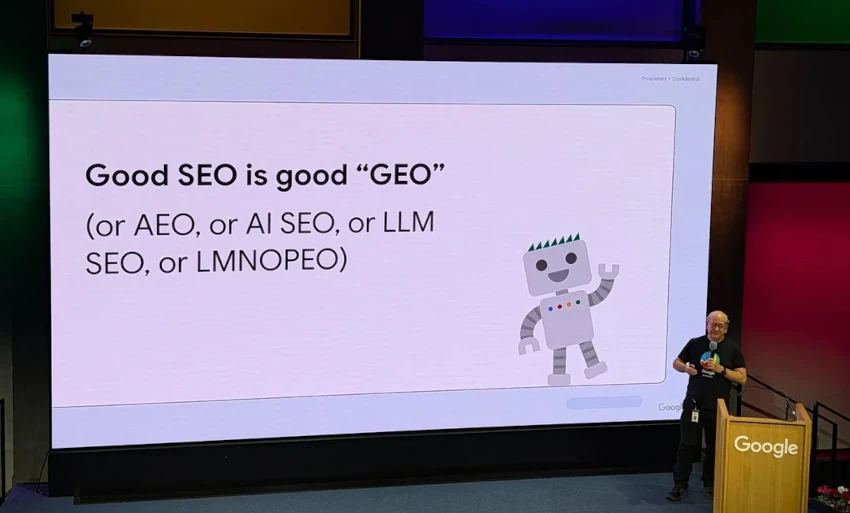
Google: Google SEO is Good GEO
Anxious because of GEO? Google officially says: Stop chasing gimmicks—just do SEO well.
“Several people have told me recently that SEO is outdated and that you have to do GEO—generative engine optimization. Some also say you need to build some kind of LLMS.txt file, chunk your content, and rewrite specifically for AI… Which of these are actually useful, and which are just hype?”
I’ve been asked this question no fewer than ten times this year. Coincidentally, Google Search Central recently released an official guide specifically about “how to succeed in Google’s generative AI search features.” I read through it, and the core conclusion may be different from what you think.
I. Google’s Official Stance: GEO/AEO Is Essentially SEO
The guide says it very plainly: the so-called “AEO” (answer engine optimization) and “GEO” (generative engine optimization) are still essentially part of SEO.
Put simply—Google’s AI search features (AI Overviews and AI Mode) are built on top of Google’s core search ranking and quality systems. None of the SEO work you’ve done before has been wasted. Indexing, crawling, ranking, content quality—all the old rules still apply.
Hearing this, some people breathe a sigh of relief, while others mutter to themselves: “So what exactly should I do?” Keep reading.
II. How Does Google AI Search “Select” Your Website?
Google AI search relies on two technologies. Here’s an analogy to help you understand:
Retrieval-augmented generation (RAG)—put plainly: AI first “fishes out” the latest web pages relevant to the user’s question from the Google search index, extracts key information, verifies and confirms it is reliable, then organizes it into an answer, and finally attaches source links.
You can think of it like this: when a user asks a question, AI does not make up an answer out of thin air. Instead, it first goes to the library (the search index) to look through books (web pages), finds the relevant passages, extracts them, and organizes them into a report—with references attached at the end of the report.
Query fan-out—when a user searches one question, AI automatically “dispatches” multiple sub-questions to search. For example, when searching “how to deal with an overgrown lawn,” AI simultaneously searches sub-questions such as “best weed killer,” “weed control without chemicals,” and “how to prevent weeds,” then summarizes the results into an answer.
The takeaway for you: your page does not necessarily have to exactly match the user’s search terms—as long as the content is relevant and valuable, it has a chance to be picked up when AI fans out queries.
III. Stop Using These “AI Optimization Gimmicks”
In the guide, Google specifically lists a “can safely ignore” list:
| Practice | Google’s Response |
| Building an LLMS.txt file | Google Search does not use this file. Building one won’t improve rankings, and not building one won’t cost you points. |
| Content chunking | There is absolutely no need to deliberately split content to cater to AI. The system can understand the nuances of multiple topics on the same page. |
| Rewriting content specifically for AI | There is no need to change your writing style. AI can understand synonyms and search intent, so there’s no need to worry about not having enough long-tail keywords. |
| Deliberately pursuing fake “mentions” | It doesn’t work. The core ranking system surfaces high-quality content, the spam system handles interception, and AI features are rooted in this. |
| Over-pursuing structured data | AI search does not require structured data, nor does it require special schema markup. But as part of an overall SEO strategy, it is still recommended. |
In one sentence: Stop spending money on these “AI-only” optimizations. What you should really focus your energy on is below.
IV. The 5 Things You Should Really Do
Here are the core recommendations from Google’s guide, distilled into 5 points:
Write content others can’t write. Google gives an example: homogenized content such as “7 tips for first-time homebuyers”—anyone can write it, and it has no value. Non-homogenized content such as “Why we skipped the home inspection and saved money”—it provides unique experience and insight. If you’re in the photovoltaic export business, the pitfalls you’ve hit over ten years, the real data you’ve obtained, and the trade show experiences you’ve had—AI can’t make those up. Add them in, and that’s your moat.
Make your site properly crawlable. Content must be publicly accessible and crawlable by Googlebot. For sites using JS frameworks, make sure content isn’t blocked. Put plainly—open the door first so AI can come in and read.
Provide a good page experience. It should look comfortable on all devices, load fast enough, and let users distinguish at a glance between main content and navigation/ads.
Reduce duplicate content. Duplicate content wastes crawl resources and affects user experience. Copy-pasting dozens of versions of a product specification page—Google doesn’t like that.
Monitor with Search Console. After verifying your site, use the “Generative AI performance report” to check how your content is being exposed in AI search. Only with data can you have direction.
V. Final Thoughts
One sentence at the end of Google’s guide left a deep impression on me: much content can shine in AI search even without any deliberate SEO treatment. You don’t need to cover everything to succeed.
So don’t be anxious. Do your content well, build a solid SEO foundation, and opportunities in AI search will naturally come to you. As for those flashy “GEO-only” services, first ask them to provide official Google evidence. If they can’t—don’t pay.